

MATLAB CODE FOR CIRCULAR CONVOLUTION
The
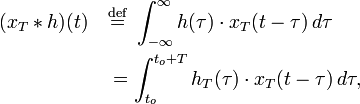
circular convolution, also known as cyclic convolution, of two aperiodic
functions occurs when one of them is convolved in the normal way with a
periodic summation of the other function.
That situation arises in the context of the Circular convolution
theorem. The identical operation can
also be expressed in terms of the periodic summations of both functions, if the
infinite integration interval is reduced to just one period. That situation arises in the context of the
discrete-time Fourier transform (DTFT) and is also called periodic
convolution. In particular, the
transform (DTFT) of the product of two discrete sequences is the periodic
convolution of the transforms of the individual sequences.

CODE:
clc;
disp('Input :');
x=input('Enter the first sequence : ');
h=input('Enter the second sequence : ');
N1=length(x);
N2=length(h);
N=8;
x=[x zeros(1,N‐N1)];
h=[h zeros(1,N‐N2)];
M=[0:1:N‐1];
disp(M);
h=h(M+1);
disp(h);
M=mod(‐M,N);
disp(M);
for n=1:1:N
M=n‐1;
p=0:1:N‐1;
q=mod(p‐M,N);
disp(q);
hm=h(q+1);
H(n,:)=hm;
disp(H(n,:));
end
y=x*H;
disp('Input :');
x=input('Enter the first sequence : ');
h=input('Enter the second sequence : ');
N1=length(x);
N2=length(h);
N=8;
x=[x zeros(1,N‐N1)];
h=[h zeros(1,N‐N2)];
M=[0:1:N‐1];
disp(M);
h=h(M+1);
disp(h);
M=mod(‐M,N);
disp(M);
for n=1:1:N
M=n‐1;
p=0:1:N‐1;
q=mod(p‐M,N);
disp(q);
hm=h(q+1);
H(n,:)=hm;
disp(H(n,:));
end
y=x*H;
%plot;
n1=0:1:N‐1;
n1=0:1:N‐1;
subplot(3,1,1);
stem(n1,x);
title('First sequence');
xlabel('Sample...');
ylabel('Magnitude...');
stem(n1,x);
title('First sequence');
xlabel('Sample...');
ylabel('Magnitude...');
subplot(3,1,2);
stem(n1,h);
title('Second sequence');
xlabel('Sample...');
ylabel('Magnitude...');
stem(n1,h);
title('Second sequence');
xlabel('Sample...');
ylabel('Magnitude...');
subplot(3,1,3);
stem(n1,y);
disp('The output is y= ');
disp(y);
title('Circular Convolution');
xlabel('Sample...');
ylabel('Magnitude…’);
stem(n1,y);
disp('The output is y= ');
disp(y);
title('Circular Convolution');
xlabel('Sample...');
ylabel('Magnitude…’);
OUTPUT:
Enter the
first sequence : [1 2 3 4]
Enter the
second sequence : [1 0 1 0 1]
The output
is y=
1 2 4 6 4 6 3 4


(h)
ReplyDeletenot running properly in matlab
ReplyDeleteCircular convolution is one of the fundamental operations in Digital Signal Processing and plays an important role in communication systems, filtering, spectral analysis, and multimedia applications. Students working on Final Year Projects for ECE can gain valuable practical experience by implementing DSP algorithms using simulation tools such as MATLAB and applying them to real-world signal processing problems.
DeleteThe article also demonstrates how mathematical modeling and software-based simulations simplify the understanding of complex engineering concepts. Exploring Final Year Project Domains for ECE can help students discover advanced areas such as Digital Signal Processing, Communication Systems, Image Processing, and Embedded Systems, where these techniques are extensively applied.
its work only for a fixed 5 element and 4 element sequence, if we use some two other sequence this program will not work. :-|
ReplyDeletegalat hai tera
ReplyDeleteA324E36180
ReplyDeleteGörüntülü Sex
Whatsapp Şov
Telegram Show Kanalı